


Issues of Audience (Diary Notes: July 2010)
I have settled on some issues of ‘audience’ that have been bugging me for some time. By ‘audience’ I am alluding to the ‘ideal viewer’ which, as Jeff wall suggested, exists in the mind of every artist. For instance, if the work is trying to express a social issue, that audience is a large segment of society; if it is conceptual art, then maybe a more art-savvy, informed and discerning viewer. Issues of ‘elitism’ abound, I have discovered that my work, while to some extent is open-ended when it comes to what any given individual can ‘get’ from the work, has got an ‘ideal viewer’. This is evident in my decision process thus far, as I have become more and more submerged into the work (Note to self, June 2010: “I have also to question whether people see this project solely as social commentary when frankly I do not?”) I have to acknowledge that my work was not about the recession, not about the landscape, not about social conditions, not about the economic conditions, not about documenting what is simply there. It is, at some levels all of these things. But, at its very essence, my work is also not about these things. It was and is, however, in its very nature, about one thing – its about ‘photography’! It was and is about my own explorations of photography – about changing approaches, about forcing a certain vision that I hope to me my own, about finding the right expression to suit the ‘aura’ of the landscape; it was about consciously adapting my approach to an ever-changing landscape which would somehow ‘express’ the social, cultural and economic condition or ‘state’ of my country as reflected in the landscape. It is a complex interplay between subject and that subjects representation. I feel I used the landscape, the economic reality of that landscape, to explore photography. My audience are people who may recognize and identify with this. Maybe?.
Abstract Documentary (Diary Notes: July 2010)
Another question to be grappled with is: How far abstract can one go and still remain documentary? What may seem a contradiction in terms is something I like to explore. In fact at the last meeting of Reflexions Masterclass, director of the European House of Photography Jean-Luc Monterosso commented that this approach was a nice ‘hook’ throughout my work which ‘pulled and pushed’ the viewer in extreme ways. The lack of sense of scale needs, at certain points, to be ‘grounded’ in reality. Yet, not too much. (Note to self: should the tripod, when visual in the picture, be in the same position every time?)
Rhetoric, Document and Lunar Landings (Diary Notes: Sept 2010)
There is a rhetoric of ‘suspension’ implicit in many of the images (the title itself suggests a country in a condition of economic immobility). There is also in parts the perception that one is ‘suspended’ – hovering, floating, hanging over these landscapes – where there is no real sense of scale or size; where there is a disconcerting lack of contact with the physical and with the real (Note to self: Can this express anything about the psychological condition of the present?) There is also a visual rhetoric of ‘exploration’ in some of the images – one is, hopefully, subtly reminded of the visual iconography of lunar landings and visually connect the terrestrial ambiguities presented in here (Note to Self: Why this approach?)


Closure!?!
This particular cycle of work is coming to a necessary end. I am struggling to bring a sort of closure to this project. The reality that this does not suit a book format, that it is most effective when printed large and experienced in a gallery context, is a positive realization for me. My plan is to find out-of-gallery locations to exhibit (perhaps empty shop units, factories, or maybe a one night exhibition in the darkness of an abandoned estate in Longford, for instance). I am unsure at this point about the financial realities that may thwart my wild ideas, but, its worth a shot. I feel the work is at its most relevant right now and it needs to be shown. I may need help! Any sympathetic philanthropists out there take note.


 There is a sense of vacancy about my series of blank exhibiting boards, for instance. They are taken just after the students take their work down after their end of year show. The little squares are one half of the hanging mechanisms which remain attached after the work is stripped from the boards. This work is not about resentment or antipathy towards students or towards my job. Its about ‘detachment’. It speaks of a certain reality of these transient, ephemeral relationships which are built year upon year between myself and my students. In a way, it is my attempt to deal with the departure of people who I have invested so much paternal energy and time into - ‘facilitating learning’ as the textbooks proclaim. This series reflects that point of departure. Maybe that feeling that is manifest in me has to do with the reality that these boards and those half hanging mechanisms are all that is physically left for me after my yearly investments in other peoples work. There is also the reality of times relentless melt and the passing of yet another year.


 June 2nd 2010
The following Images were taken before and after and around some of my classes with this years graduates (September 2008 - May 2010).
 Sept 29th 2008. Class 3. Notes
 After 907 class. Feb 2009
 Sept 2008.
On Defining Borders
Borders define certain spaces. They immediately give notions of demarcating geographic boundaries - separating nations, cultural entities, economies and peoples. They signify division - conflicted or contested landscapes, either side of a divide, which are forced into duality and opposition. In this regard, a border represents history drawing lines in the sands of geography. It is the definite entity inscribed into a landscape - the ‘place’ where there is a union, a contact-point, a barrier or a separation.
On Border Experiences
Yet, every border is equipped with its own set of conditions. Personally, I think of my trips through-out South-East Asia and the various crossing-points between countries: the 5ft wide river that separates Burma from Thailand in Tachilek and the stark differences between the two places; the presumably unauthorized border control I encountered while entering Cambodia from Laos on a small wooden boat – where an ‘officer’ dressed in army gear from the waist up and Bermuda shorts from the waist down stamped my passport before I was swindled out of 5o dollars to retrieve my backpack, which had been anchored off shore in a boat by three local grifters. I think of Laos itself – a country defined from a buffer zone to keep waring factions apart. I think of the time I mistakenly entered into American soil from the Canadian side without my passport (just trying to take a picture, stupid kid, of where they both meet) and suffered the humiliation of hyper-strict border controls on both sides. I also think of the boat crossing between Tarifa in Spain over to Tangiers and the distinct cultural differences between North Africa and Southern Europe.

Tachilek, Thai/Burma Border. 2005
 Cambodia. 2005
 Interzone. Tangiers. 2002
On Borders Within the Image
A constant physical and psychological ‘border’ within all photography is the barrier(s) which exist between the photographer and the world photographed. Just by looking at my image from Tangiers, for instance, we can identify this to a degree. This image fell out of two-three rolls of film I shot whilst I approached the coast of Tangiers from Spain. This was my first sight of North Africa and was a visually stimulating couple of minutes and the image is amongst my favourites from my work to date. But, briefly, and in a critical way, we can suggest three borders which inhabit and are enclosed within the image itself – apart from the obvious border photographed between North Africa and Europe. Firstly, the border between my own subjective perspective and the physical surface of the world I am looking at. Secondly, the glass of the docking boat which adds to this sense of distance between inside and outside and maybe adds to the ‘being-there-ness’ quality of the image. And, finally, the actions of the camera itself - focus, use of depth of field, blur, etc - which reinforce that distance and emphasize that boundary between inside and outside worlds, between subjective and objective perspectives. The camera makes each invisible to an extent. When Susan Sontag suggests that images “hide more than they reveal” she is partly referencing this very notion. The photographer tries to naturalize the images true-to-nature views and hide the construction beneath the seductive surface of the image. Here it is evident. I wanted the viewer to share my visual experience of that moment of that scene as it opened up in front of my eyes. Similarly, the below images of a morning in a hotel in Marseille and the water seperating North and South New Zealand try to share the sense of visual experience and share my sense of zest for that subjective moment.


Future Projections. Napoli. 2001

Bangkok. 2004

New World. Wellington, NZ. 2004


On Undefined Borders
Part of the Midlands work, in essence, dealt with the notion that while many areas have demarcation points, the ‘midlands’ was essentially an undefined entity – a non-geographic, non-place which was under constant construction and redefinition at the height of the development. The work suggested and described the ‘porosity’ of the sorts of borders that existed in both rural towns due to suburbanization and the conceptual expansion of the midlands region. It was difficult to identify any definite border which demarcated where the midlands began and where it ended. I remember seeing shop units and commercial paint vans in Wexford and in Mayo, for instance, which proclaimed their business as ‘Midlands Electrical’ or ‘Midlands Paint Contractors’. Thus, maybe part of the project suggested that the Midlands was partly defined through commercial desires to break out of the limitations of ‘the local’. (Sidenote: An underlying theme of the project showed the effects of globalization, maybe, and economic ‘liberalization’, or speculative lassie-faire economic policies, which have made traditional borders increasingly impermeable.)

On the Subjective Border
Photography can also explore borders from an autobiographical perspective according to subjective perception. On a deeper level, a border can relate to an opposition between an inside and an outside world – between subjective and objective or between what is intimate and what is external. My recent ‘Sketches From Home’ series is about the relationship between my rural background and my photographic work – a reflexive body of work which tries to explore, in a real way, the sense of guilt, the sense of ambivilance to breaking family lineages, maybe(?). With this project there is a direct attempt to explore the tension between two impulses – tradition vs artistic. The camera can, in this regard, bring together two worlds for a clearer understanding of both.

With this on-going work, there are also vulnerabilities. To allow others to visually trespass into my inviolable space (again, crossing my own personal boundaries). Here others can view how I negotiate my own nature through photography - a medium that has opened up new worlds and perspectives to me. Hopefully people will understand that I try to explore my nature in an open and honest way. I feel that much of the works I have seen of this theme of ‘lost traditions’ when it comes to rural life is documented by outsiders who naturally promote a strong sense of ‘loss’ or demise (of culture, or tradition, or whatever) or a highly emotive sense of pathos. The real conditions of rural life to the outsider is mis-understood. I want my work to be as subjective as it can be – to explore the real conditions of my own relationship with rural life. I no longer live in rural Ireland, but it is very much a part of who I am. I feel that each time I use the camera, I force a new understanding of my life, my culture, the landscape, and the medium of photography itself and how and why I use it.
 Between the Ideal and the reality. Kho Samui, Thailand. 2004
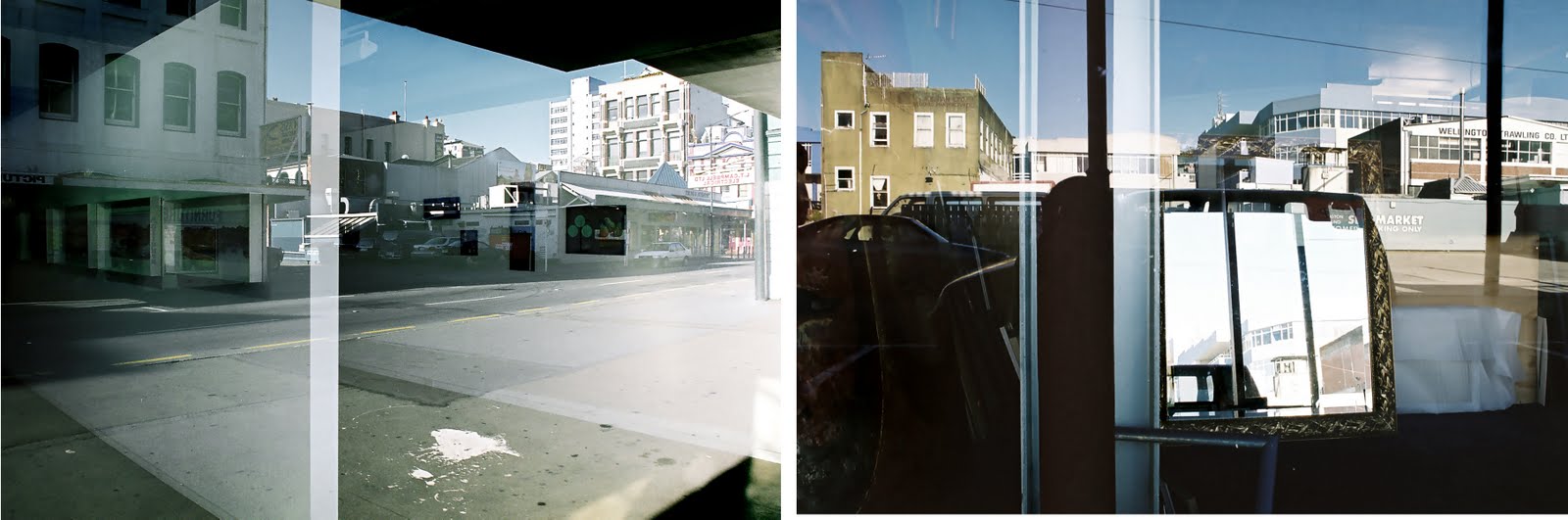 Broken Visions Series, Wellington, New Zealand 2004
 Torn European Election Poster, Prague, 2007
 Self Portrait with Queuing Ships, Singapore 2005
 Divisions, Phnom Penh. 2005
 Camping Ground. Australia. 2005
 IFSC, Dublin. 2005
 From the Series Thirdspace. Just before the opening of new buildings in Dublin’s Docklands. 2005


